

Couples & Relationship Therapy in Nashville & Mt. Juliet, TN
The same fight on repeat. The distance that crept in slowly. You're not the first, and it isn't hopeless.
Most couples don't come in because something dramatic happened. They come in because they've become polite with each other, or because the same argument has been running for three years in different clothes. Both are worth taking seriously.
Schedule a Free ConsultationIt's Rarely About the Dishes
Most couples can recite their argument by heart. One of you pushes for resolution; the other needs space and goes quiet. One raises a concern; the other hears an accusation. Within ninety seconds you're both defending yourselves and neither of you is talking about what actually started it.
That pattern is the thing to treat — not the dishes, the tone, the in-laws, or the text that went unanswered. Couples get stuck not because they lack love or effort, but because they've fallen into a loop where each person's coping move triggers the other's. The harder you both try inside that loop, the more entrenched it gets.
Other couples arrive with something quieter and harder to name. No fighting at all — just efficient logistics, separate rooms at the end of the night, and the private worry that you've become roommates who co-manage a household well. Disconnection doesn't announce itself the way conflict does, which is exactly why it's often further along by the time anyone says it out loud.
As a Licensed Marriage and Family Therapist, relationships are the training I was actually built on. My work looks at what's happening between you — including how each of your histories shows up in the room, usually without either of you intending it.
What Sessions Are Actually Like
It isn't a courtroom. The most common fear couples bring is that therapy will be an hour of taking turns building a case, with me issuing a ruling at the end. That's not how I work, and it wouldn't help if it were. I'm interested in the pattern, not the verdict.
We slow the loop down. Much of the early work is catching the cycle in real time — noticing the moment one of you shifts into protecting yourself, and what the other person did just before that. Seeing it happen live is far more useful than describing it after the fact.
We find what's underneath the position. Under most criticism is a fear of not mattering. Under most withdrawal is a fear of failing you. Partners rarely hear each other's underneath, because it arrives dressed as an attack or a shutdown. Getting to it changes the conversation.
We account for your histories. Both of you learned what conflict means, what closeness costs, and whether needs get met, long before you met each other. When old material is driving a present-day reaction, I can work with it individually using EMDR or IFS — so it stops detonating in your marriage.
What Couples Bring In
You don't need a crisis to justify coming. Plenty of couples come in maintenance mode, or because one thing has been sitting unresolved for a long time.

Communication & Recurring Conflict
The argument you've had a hundred times. Escalation, stonewalling, and the sense that you're speaking different languages about the same thing.
Disconnection & Intimacy
Feeling like roommates. Mismatched desire, physical distance, or affection that quietly stopped somewhere along the way and neither of you knows how to restart it.
Trust, Betrayal & Repair
Infidelity, financial secrecy, or a broken promise that changed things. Repair is genuinely possible, and it takes structure rather than time alone.
Parenting, Blended Families & In-Laws
Different discipline instincts, stepparent dynamics, and boundaries with extended family — plus the resentment that builds when one partner carries more of the load.
Couples Navigating Fertility, Pregnancy, Postpartum & Loss
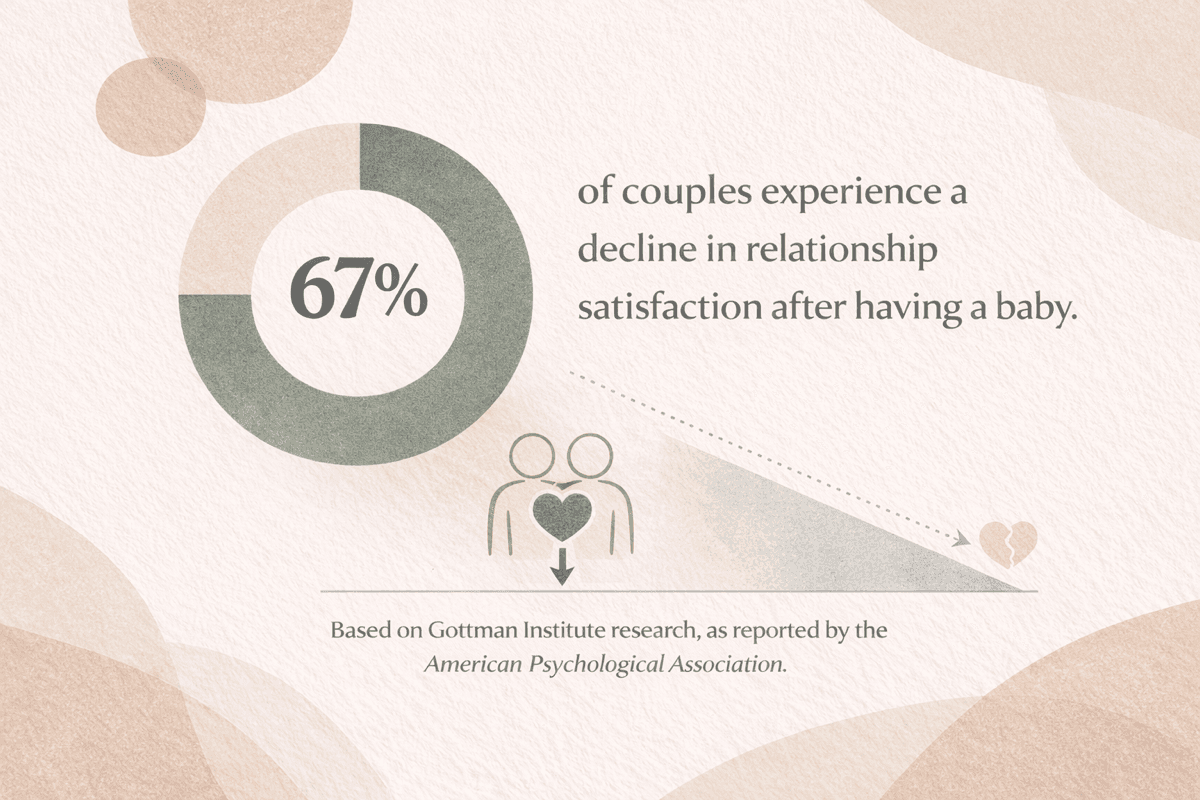
Research consistently shows relationship satisfaction declines for most couples in the transition to parenthood — even in healthy, loving relationships. That isn't a sign something is wrong with you. It's a sign you're being asked to adapt enormously under conditions of significant stress and sleep deprivation.
Add infertility, pregnancy loss, or a difficult postpartum period, and the strain intensifies. Partners often grieve differently, communicate differently under stress, and can feel like strangers to each other during one of the most significant periods of their lives. This is the work I hold advanced PSI training in.
Infertility & Fertility Treatment
Medicalized sex, financial stress, different grief styles, and the question of “how much is enough.” Therapy helps you stay connected when the process feels dehumanizing.
Pregnancy Loss & Grief
Partners grieve differently — at different paces and with different needs. Therapy can help you understand each other's grief without taking it personally.
Postpartum Transition
Sleep deprivation, role shifts, physical changes, and identity upheaval — one of the highest-stakes transitions a relationship faces. Coming to therapy is taking it seriously.
Perinatal Diagnosis
An unexpected diagnosis about your baby is a profound shock. Couples often need support both individually and together to navigate decisions, grief, and uncertainty.
Session Format Options
I offer 50-minute standard couples sessions ($175) as well as half-day (3-hour, $500) and full-day (6-hour, $1,000) intensive options — a deeper format that allows for more thorough exploration without the constraints of a typical therapy hour. See the Fees page for full pricing details.
Frequently Asked Questions
You're still on the same team.
The hardest part is reaching out. Both of you, or just one of you to start — either is welcome.
No commitment required · Completely confidential